



Friday Features
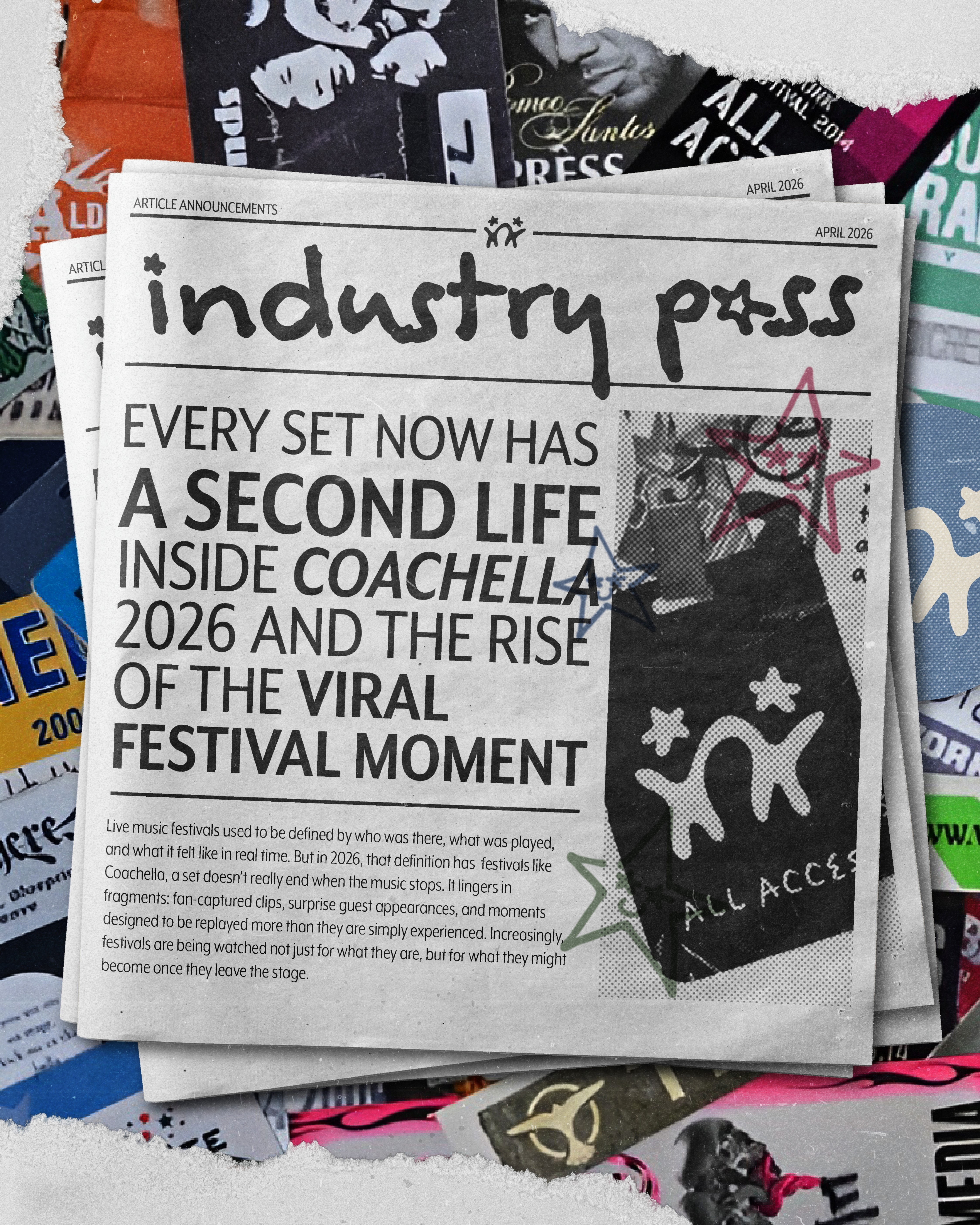
Every Set Now Has a Second Life: Inside Coachella 2026 and the Rise of the Viral Festival Moment
Kaitlin McKay
There’s a new kind of silence at festivals, and it happens right after something goes viral.
Live music festivals used to be defined by who was there, what was played, and what it felt like in real time. But in 2026, that definition has shifted.
At festivals like Coachella, a set doesn’t really end when the music stops. It lingers in fragments: fan-captured clips, surprise guest appearances, and moments designed to be replayed as much as they are experienced. Increasingly, festivals are being watched not just for what they are, but for what they might become once they leave the stage.
From Justin Bieber bringing out Billie Eilish, to Madonna joining Sabrina Carpenter, to Olivia Rodrigo appearing during Addison Rae’s set—each surprise seemed to raise the stakes for the next.
By the end of the weekend, it felt like every set had the potential to turn into the next viral clip.
And that’s what defined the experience.
It wasn’t just that moments went viral. It’s that they felt like they were built with that possibility in mind. Every set carried the sense that something unannounced could happen at any time, and that unpredictability became part of the appeal.
But it also changed how the audience engaged.
What used to be a contained live experience now extends outward almost immediately—reframed through phones, feeds, and replay culture. A performance is no longer only judged in the moment it happens, but in how it lives on afterward.
By the second weekend, it wasn’t just about who you came to see. It was about what might happen while you were watching.
Each moment built on the last, creating a rhythm where the audience wasn’t just waiting for their favorite artist—they were waiting for the interruption, the surprise, the clip they’d see again later.
And in those moments, when that shift happens each night, every set carries a new kind of pressure.
Artists spend months building toward these performances—crafting setlists, planning visuals, and creating moments meant to land with thousands of people at once. But now, those moments aren’t just for the crowd in front of them. They’re for the camera. For the clip. For social media. For what happens after.
And the audience feels it too.
Somewhere along the way, the experience of being at a show has started to compete with the instinct to capture it. Fans hold their phones up not just to remember the moment, but to document it—to get the right angle, the clearest shot, the version that might travel beyond the crowd they’re standing in. The result is a subtle shift: instead of fully experiencing the show, many are watching it through a screen.
It raises a strange question—what does it mean to “be there” if you’re not really in it?
I’m not saying don’t record anything. Everyone does. I do. There’s a difference between capturing your favorite song and filming an entire set. But the balance feels like it’s changed. What used to be a live experience first, with documentation as a bonus, is starting to feel reversed.
And it’s never been more visible than it was this year.
Watching the Coachella 2026 livestream—especially during Sabrina Carpenter’s set—it was hard to ignore. The crowd wasn’t faceless, but it almost looked like it: thousands of phones held in the air, camera flashes scattered across the field, entire moments experienced through screens instead of directly in front of them. Justin Bieber’s set reflected that same shift in a different way. At one point, he leaned into the viral nature of the moment, pulling up clip after clip and projecting them to the crowd—blurring the line between live performance and the content that follows it.
At the same time, the moments themselves kept getting bigger. Artists debuted never-before-heard songs and brought out high-profile collaborators, each trying to create the set that would travel the furthest beyond the festival. In that environment, even the idea of a “full experience” begins to change. It’s no longer just about watching a set from start to finish, it’s about catching the moment everyone else will be talking about afterward, being one of the few who saw it live and having it saved somewhere in your camera roll.
At Coachella, the performances didn’t end when the lights went down. They ended when the clips stopped circulating; something that, for many sets, hasn’t happened yet. Somewhere between those two moments, a new version of live music is taking shape—one defined as much by what happens after as what happens in real time.
And as those moments continue to live on, it’s worth wondering what we’re actually holding onto, and what we might be losing in the process.